The playbook: How to evaluate and compare contract drafting and review software
 Michaelle Noble

So, your legal team is researching AI contract drafting tools. You’ve sat through the demos, read the feature pages, maybe even started with a spreadsheet. And now you’re wondering: how do we actually compare these things?
TL;DR
Picking the wrong contract drafting tool is expensive – in time, adoption pain, and risk. This playbook gives in-house legal teams, legal ops leaders, and law firms a structured, outcome-first framework for evaluating AI contract drafting and review software. You’ll learn how to define your baseline, assess vendors across seven dimensions that actually matter, and map product capabilities to real business outcomes. LawVu Draft is referenced throughout as an example of how a purpose-built tool can meet these criteria – from native Microsoft Word integration and AI risk detection to embedded playbooks and a shared knowledge base.
The honest answer is that most vendor comparisons end up being a race to the bottom – whoever has the longest feature list, the slickest UI, or the most impressive AI branding tends to win. But feature lists don’t tell you whether a tool will actually stick once your lawyers are back at their desks drafting real contracts under real deadline pressure.
This playbook is built for in-house legal teams, legal operations leaders, and heads of legal who want a better way to evaluate. It’s also relevant for law firms assessing how AI contract tools can improve client delivery and efficiency. Instead of comparing features in isolation, we’ll walk through how to assess performance in real legal workflows – and what drives lasting value after go-live.
Step 1: Define what “good” looks like for your team
Before you talk to a single vendor, get aligned internally on what success means. Without a shared definition, evaluations drift toward features that look impressive but don’t solve real problems.
Start with a baseline measurement. Ask yourself and your team:
- What types of documents do you review most often?
- How frequently do you review them – weekly, monthly, or by deal?
- How long does each review take, start to finish?
- What efficiency gains are you targeting, and how will these translate into time and cost savings?
These aren’t abstract questions. They become your evaluation lens. Every vendor conversation, demo, and trial should be measured against them. If a tool can’t show you how it improves your baseline, it’s not ready for your team – no matter how good the pitch is.
Step 2: Evaluate vendors across seven critical dimensions
Once you have a baseline, it’s time to look at vendors. The following seven dimensions are the ones that matter most for legal teams doing real contract work. They’re not comprehensive – every team will have its own priorities – but they cover the ground where tools most often fail to deliver.
1. Workflow integration
Start with where your lawyers work. Does the tool operate natively inside Microsoft Word, or does it require a separate editor or platform?
This sounds like a small detail, but it’s one of the biggest predictors of adoption. Most legal teams draft, review, and redline inside Word. Forcing lawyers to move into a new environment – even a Word-like one – introduces friction that slows work and tanks adoption rates.
LawVu Draft can operate directly inside Microsoft Word, keeping lawyers in the environment they already know. That native integration makes it easier for teams to adopt new capabilities without changing familiar habits.
“Many solutions require lawyers to work in separate platforms with Word-like text editors, which adds unnecessary friction. LawVu Draft’s deep integration with Microsoft Word was a major advantage for us. It supports our team in their existing workflow rather than forcing a system change, while also allowing us to fully leverage Word’s native formatting and tools. This makes adoption much more intuitive and ensures a seamless drafting experience.”
Yunna Choi, Head of Legal Operations & Innovation – Axel Springer
2. Drafting efficiency
Next, assess how quickly lawyers can create and update contracts using the tool. Speed should come from reuse and structure – not just AI-generated text.
Look for these specific capabilities:
- Document automation that generates first drafts from your own templates
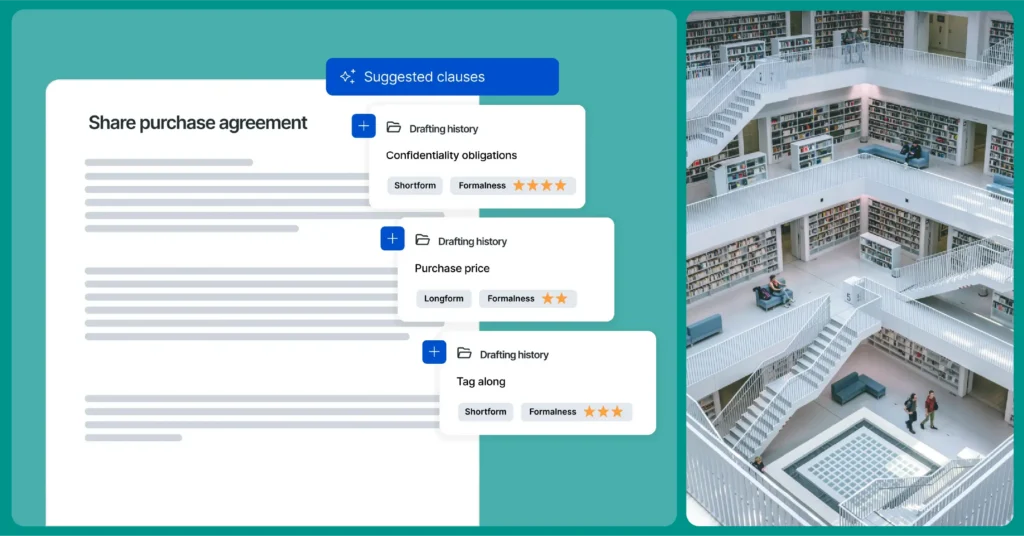
- One-click clause insertion from your organization’s drafting history
- Automated checking of capitalized term definitions
LawVu Draft can generate tailored contracts from smart templates, insert AI-powered clause suggestions based on document context, and help lawyers understand complex language through instant summaries – all inside Word.
These aren’t the flashiest features, but they reduce repetitive work and help teams move faster without sacrificing quality. Florence Cordonnier, Legal Consult Manager at Acerta, put it well:
“LawVu Draft allows our consultants to provide the best possible service to our clients while eliminating the need for repetitive, time-consuming labor on our end. We are excited to continue exploring applications of document automation to change the face of HR consulting.”
Florence Cordonnier, Legal Consult Manager – Acerta
3. Institutionalized knowledge
The right tool should apply your organization’s standards consistently across agreements – not just generate plausible-sounding legal text.
Think of AI like an exceptionally eager new hire: it’ll immediately get to work on whatever you put in front of it. But the fewer constraints and guidance you give it, the higher the chances are that the output will leave a lot to be desired. The best tools enforce your institutional knowledge automatically.
LawVu Draft can capture your best clauses, templates, playbooks, and precedent contracts in a shared knowledge base. It can provide context-aware clause suggestions pulled from your own clause library, transform precedents into intelligent templates with dynamic placeholders and conditional logic, and connect to existing knowledge repositories like SharePoint and iManage.
That’s not AI replacing legal judgment – it’s AI applying your team’s judgment at scale.
“LawVu Draft allows our in-house lawyers to centrally manage contracts and make them available in an intelligent, user-friendly way to colleagues who need them. In this way, we streamline the operation between the legal department and the rest of the company and increase the quality of our documents.”
Fabienne Lallemand, Chief Legal and Compliance Officer – SD Worx
4. Risk detection and AI support
AI should support legal judgment, not replace it. The most effective drafting tools use AI to surface issues based on your organization’s own standards – not generic risk signals.
LawVu Draft can automatically flag risky language, inconsistencies, and missing provisions in real time, highlight non-compliant clauses against your custom playbooks, and compare clauses and alternative language across documents so lawyers can quickly evaluate and insert the best option. By identifying risk early, these capabilities reduce downstream review and negotiation time.
The distinction matters: a tool that flags generic risks is helpful. A tool that flags deviations from your approved standards is transformative.
5. Collaboration and negotiation
Drafting rarely ends with the first version. Effective tools need to support the full negotiation lifecycle – tracked changes, comments, version control, and clause comparison.
LawVu Draft can redline contracts instantly using your preferred language, compare third-party contract language against your clause library, and support approvals and handoff to signature without forcing users to switch systems or export documents.
6. Adoption and usability
Even the most capable software fails if people don’t use it. Adoption is the single biggest variable in whether a legal tech investment pays off.
Look for intuitive design, minimal training requirements, and fast time-to-value. LawVu Draft can enable self-service through guided questionnaires that allow colleagues to create simple agreements that meet your standards – freeing lawyers to focus on higher-value work. Tools that fit existing workflows are far more likely to be adopted than those requiring significant behavior change.
Dr Frederik Leenen, former Head of Legal Tech at CMS, summed it up well:
“It covers the best of the old world and includes the new world of AI, blending them into something that is very neatly done. LawVu Draft is kind of a Swiss army knife. It has many different tools that all help you do what you expect them to do.”
Dr Frederik Leenen, former Head of Legal Tech – CMS
7. Platform fit
Finally, consider whether the drafting tool stands alone or is part of a broader legal operating system. Both approaches have trade-offs.
Standalone tools are easier to implement but can create silos and limit visibility. Integrated platforms may take longer to go-live, but they connect drafting with contracts, matters, documents, and reporting – giving teams a single source of truth and better operational control.
LawVu Draft is purpose-built for both law firms and in-house legal teams, and it connects to the broader LawVu legal operating system. That means drafting activity doesn’t live in a vacuum – it feeds into the contract and matter management layer that legal ops leaders need to report on and optimize.
Step 3: Use a vendor comparison table
Once you’ve defined your criteria, a simple scorecard helps compare vendors consistently. The table below puts five of the leading AI contract drafting and review tools side by side across the eight dimensions that matter most. Use it as a starting point – adjust the weighting to reflect your team’s priorities.
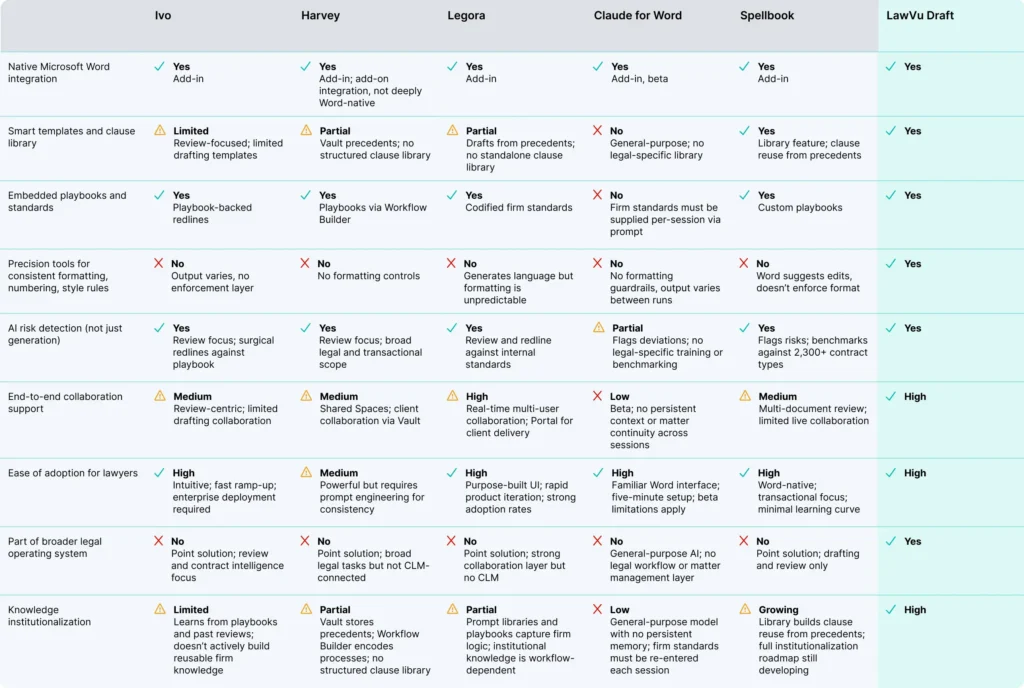
A few things stand out from this comparison. Ivo is the strongest purpose-built option for high-volume contract review – its surgical redlines and playbook enforcement are best-in-class, but it is primarily a review tool, not a drafting platform. Harvey is powerful for broad legal work across practice areas and has strong enterprise credentials, but it requires meaningful prompt engineering to get consistent output, and knowledge lives in Vault rather than a structured clause library.
Legora has made rapid product strides and is strong on collaboration, particularly for law firms sharing work with clients through Portal, but it remains a point solution without CLM connectivity. Claude for Word is a compelling general-purpose entrant that is genuinely good at document analysis and tracked-change editing, but it lacks legal-specific training, has no persistent memory between sessions, and is still in beta. Spellbook is the most accessible option for transactional drafting, especially for law firms, with its Library feature building institutional knowledge over time, though full knowledge institutionalization is still maturing.
LawVu Draft is the only tool in this comparison that combines native Word integration, embedded institutional knowledge, end-to-end collaboration support, and a connection to a broader legal operating system. That breadth matters if your goal is consistent, organization-wide adoption – not just a productivity boost for individual power users.
When weighting this table, consider which dimension is your biggest constraint today. If adoption is the blocker, ease of use and Word integration should carry the most weight. If inconsistency is the issue, look hard at knowledge institutionalization and playbook enforcement. If speed is the priority, drafting efficiency and clause reuse are your key signals.
Step 4: Map capabilities to business outcomes
Capability lists are useful for internal evaluation, but they’re easier to socialize when tied directly to business outcomes. This framing also helps stakeholders outside legal understand why specific capabilities matter, and why they’re worth the investment.
Use this kind of mapping when presenting your evaluation findings to leadership or finance. It answers the question every budget holder asks, not “what does it do” but “what does it for us?”
Takeaway: Compare outcomes, not just features
The right contract drafting and review software should fit naturally with your team’s existing ways of working. It should enforce standards without slowing down the business, reduce risk while increasing speed, and give junior and senior lawyers alike the confidence to work consistently – without adding headcount.
Using this framework ensures your evaluation is structured, defensible, and focused on real legal outcomes – not marketing claims.