
How to choose AI contract review tools: a buyer’s guide for legal teams
 Connor Amor-Bendall
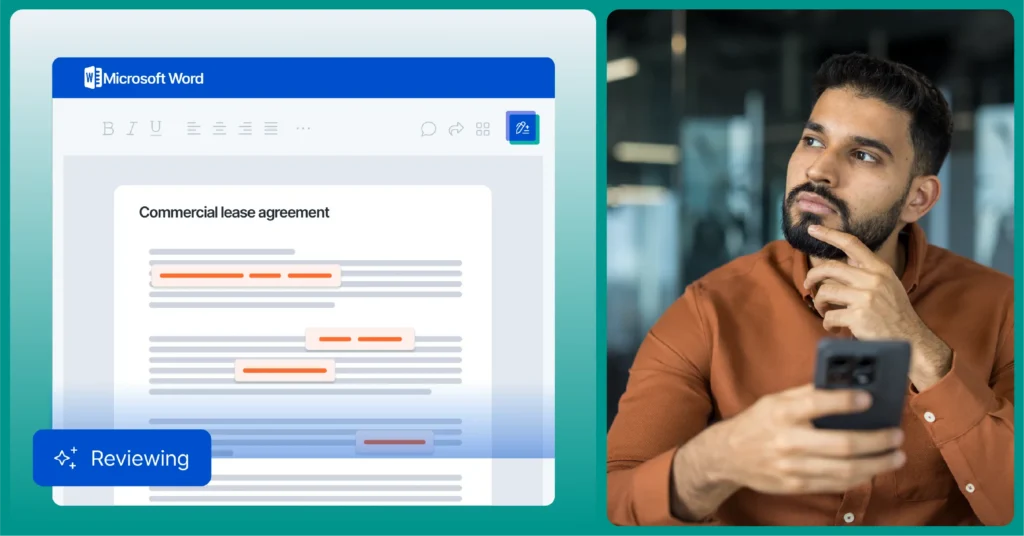
Choosing the right AI contract review tools can help you review contracts faster, apply consistent standards, and reduce negotiation friction. The best solutions go beyond contract summaries to support playbooks, clause libraries, AI redlining, and legal knowledge management inside your existing workflow.
TL;DR
- AI contract review tools help legal teams identify risks and review contracts more efficiently.
- Playbook-based review produces more consistent outcomes than open-ended AI analysis.
- Microsoft Word integration reduces workflow disruption and improves adoption.
- Clause libraries help turn risk identification into approved contract language.
- AI redlining is most effective when formatting and document structure are preserved.
- Both law firms and in-house legal teams benefit from centralized legal knowledge.
- The strongest AI platforms support drafting, review, refinement, and knowledge reuse.
- Lawyers remain responsible for legal judgment and final contract decisions.
What are AI contract review tools?
AI contract review tools use AI to help lawyersreview agreements more efficiently by analyzing contracts, and comparing language against predefined standards, to identify risks and suggest revisions.
At a time when lawyers in private practice and in-house are under increasing pressure to work faster and meet higher levels of demand, AI contract review is a real game changer.
Many legal teams make the mistake of thinking that general-purpose AI tools will apply to legal. While these tools can summarize documents and answer questions, contract review requires a more structured and specific approach.
Whether you work at a law firm or in an in-house legal team, you need technology that understands your legal workflows, approved legal language, negotiation positions, and organizational standards.
Why AI contract review matters now
Businesses across the globe have embraced technology and digital ways of working, meaning much more efficient teams and in turn, an expectation that legal meets this new barometer.
Legal teams report that they are expected to deliver faster contract turnaround times, whilst also:
- Improving consistency
- Minimizing risk
- Scaling expertise
- Supporting business growth
Manual contract review is a time-consuming process that cannot deliver the speed and accuracy needed by modern legal teams.
This is where AI can add value. If used correctly, it can support lawyers to be much more efficient in their workflow.
According to LawVu Draft, legal teams can achieve up to 5x faster contract reviews and up to 3x faster negotiations when review workflows are supported by AI, approved language, and playbooks.
What AI for law firms and in-house legal teams needs to do
What it is
A modern AI contract review platform should help lawyers review agreements against predefined standards, identify risks, suggest approved alternatives, and generate usable redlines.
Why it matters for law firms
Law firms need to deliver consistent advice across teams while maintaining profitability.
AI contract review can help firms:
- Scale expertise across practice groups
- Apply client-specific playbooks consistently
- Reduce repetitive drafting work
- Improve turnaround times
- Support alternative fee arrangements
“We are an ambitious law firm and are constantly striving to support our clients in the best way we can. LawVu Draft allows us to continue to fulfil these ambitions. Keeping pace with our clients’ evolving needs is an everyday challenge. Therefore, we try to think along with them to provide legal services in a way that is intuitive and clear. Offering legal solutions is a great example of how we put our clients’ needs first.”
Edwin Jacobs, Partner – Timelex
Why it matters for in-house legal teams
In-house legal teams need to support business growth while maintaining control over risk.
AI contract review can help legal teams:
- Standardize review processes
- Enforce company-approved positions
- Reduce contract bottlenecks
- Support business self-service
- Improve consistency across negotiations
The limitation
AI does not replace legal judgment, and it should not be used without a lawyer reviewing its output thoroughly. While AI tools can help lawyers work faster and more consistently, final decisions require human review.
Word-based vs web-based contract review
An important distinction between different AI-reviewing tools is how you use them and where they live. Some tools are web-based, whilst others are plug-ins to Microsoft Word.
Web-based
Web-based AI tools require you to upload a document to a web platform where the review can be performed.
The benefit of this approach is that it usually provides more flexibility for users.
The downside is that it requires lawyers to leave their trusted Microsoft Word environment, which hurts the rate of adoption but also means that some functionalities (format painter, track changes) are unavailable to you unless the vendor decided to implement them in their web app.
Word-based
These tools function as Word add-ins.
The benefit is that they integrateinto Word, where lawyers typically conduct contract reviewing and redlining, allowing for seamless interaction with documents.
The downside is that these tools are restricted to Word and can’t be used in platforms such as Google Docs. They are also limited to what Word allows them to do within the Word ecosystem.
The winner
We believe that word-based AI contract review tools are superior as they reduce process disruption, require less onboarding, and are easier for lawyers to adopt.
When time is so critical and negotiation cycles demand speedy contract review, lawyers can become productive more quickly with a tool that fits into their existing workflow, rather than having to learn a new one.
“LawVu Draft has a great layout-awareness where you can create different versions of clauses and compare them. When you find your perfect clause, you can insert it in Word and don’t have any formatting issues afterwards.”
Katja Grabka, Senior Legal Tech Specialist – CMS
Open-ended vs closed reviewing
When it comes to AI reviewing a contract, there are two options for how it can work. You can prompt the AI tool to do an open-ended or closed review, depending on what best suits your requirements.
Open-ended review
This approach essentially hands over the reins to AI. Rather than prompting the tool with specific issues you want it to check for, you asked it to review the document and flag any issues. Effectively, the AI performs a ‘sense check’ of the document of sorts.
If you’ve done most of the grunt work on a contract yourself, an open-ended review is very helpful as the AI acts as a second pair of eyes.
The drawback of open-ended review is its unpredictability; you don’t know what the software is going to identify as an issue and why. For lawyers, open-ended review can present more risk than it’s worth, which brings us to the second approach: closed review.
Closed review
In a closed review, you guide the AI through the process. Lawyers can create a ‘playbook’ or ‘checklist’ of pre-defined legal requirements that a contract is typically checked for. The AI then reads through the contract and cross-references it with said requirements to tell you which are met and which aren’t.
The benefit of a closed review is that you have much more control over what the AI will check and can trust that it hasn’t missed something crucial.
The more time and effort that you put into developing legal playbooks, the better the results of a closed review will be. It’s also important to factor in playbook maintenance. Legal teams must keep standards, fallback language, and preferred positions current.
For in-house teams, which typically have predefined risk positions, this effort can deliver substantial benefits.
Clause libraries
Clause libraries are a key aspect of AI contract review tools.
A clause library is a centralized repository of approved legal language, fallback positions, and drafting precedents.
For in-house legal teams, they are particularly useful as organizations often prioritize standardization and consistency in their negotiations.
Why it matters for law firms
Clause libraries help firms scale expertise across lawyers and offices.
Instead of relying on individual knowledge, approved language becomes available across the firm.
Lawyers in private practice have typically operated with an individual mindset, reinforced by the billable hour model. While clause libraries require lawyers to share their knowledge, doing so is ultimately in the best interests of the firm.
Why it matters for in-house legal teams
Clause libraries help standardize contract language and reduce negotiation variability.
It is in the company’s best interest that all team members are aligned with the risk appetite of the company. The provisions that get accepted and rejected shouldn’t depend on the personal preference of the individual lawyers doing the negotiation.
A clause library means teams can quickly access approved positions without searching through historical agreements.
AI-powered redlining
AI-powered redlining suggests edits, revisions, and alternative contract language directly within the document.
The idea behind it is simple: you have already prompted the AI to find a specific issue. Why not use that same prompt to instruct the AI to redraft the clause?
The AI can refer to the playbook to fix an identified issue with an approved legal position and produce a negotiation-ready output that can be reviewed and delivered efficiently.
The limitations
Many lawyers are skeptical about letting AI make legal judgments and decisions, and it’s important to note that AI-powered redlines should only be reviewed as a suggested edit, not a definitive fix.
A lawyer should always review and make the final call on what has been suggested.
How to choose the right AI contract review software
In a legal tech market saturated with vendors, it can be hard to determine what AI contract review software is best for you.
When evaluating vendors, focus on practical legal outcomes rather than marketing claims and ask whether the solution can:
- Support Microsoft Word workflows – for best adoption rates, lawyers should be able use the tool in Word where they already draft and negotiate contracts.
- Apply your standards – the tool should review contracts against your organization’s requirements.
- Use your clause library – risk identification is only useful when paired with approved language.
- Generate usable redlines – suggestions should be practical, editable, and negotiation ready.
- Connect to legal knowledge – templates, precedents, and playbooks should be reusable across the team.
- Keep lawyers in control – AI should support legal judgment, not replace it.
Key takeaways
- AI contract review tools improve contract review speed and consistency.
- Playbook-based review produces more predictable outcomes than open-ended review.
- Microsoft Word integration reduces workflow disruption.
- Clause libraries help transform identified risks into approved solutions.
- AI redlining is most effective when formatting is preserved.
- Law firms and in-house legal teams both benefit from centralized legal knowledge.
- The best AI contract review software supports drafting, review, refinement, and knowledge management.