Why contract template management breaks down and how to fix it
 Michaelle Noble
Every legal team has templates. Most legal teams have problems with contract templates. Here is why traditional contract templates fail in practice and what a better approach looks like.
TL;DR
- Contract templates are the most common tool legal teams use for drafting efficiency, but they carry five structural problems that erode their value over time.
- The core issue is that traditional templates are static documents stored in decentralized locations, which means they age, drift, and generate inconsistencies rather than preventing them.
- The problems compound at scale: the more templates a team maintains, the more expensive updates become, and the more versions circulate simultaneously.
- The solution is intelligent, centralized templates that update once and propagate everywhere, adapt dynamically to the situation at hand, and connect to a shared clause library.
- LawVu Draft transforms static Microsoft Word templates into dynamic, centrally managed tools in a shared knowledge base that law firms and in-house teams can rely on.
The template promise vs the template reality
Ask any legal team how they manage contract drafting efficiently, and templates will be near the top of the answer. In-house counsel teams in particular treat maintaining and updating template contracts as a core function. Law firms maintain precedent documents. Both talk about templates as a foundation for consistent, efficient drafting.
Most legal teams live with different reality. Templates that were current two years ago are still circulating. Multiple versions exist simultaneously with no clear indication of which is the latest. A legal requirement changed, and six template variants need to be updated, one by one. A junior lawyer generates a contract from a template that was quietly modified three months ago by someone in a different office and saved under a slightly different filename. The document that goes out bears only a partial resemblance to the approved version.
This is not a failure of intention. It is a structural problem with how traditional templates work. Understanding the five root causes makes it clear why the usual fixes like better file naming, stricter version control, and more regular review cycles treat symptoms rather than causes.
Five structural problems with traditional contract templates
Problem 1: Templates age quickly and silently
A template is created at a point in time. The law changes. Your risk appetite shifts. A negotiation produces a better clause that your senior counsel wants to use going forward. None of this automatically updates the template. Someone must remember to update it, have access to it, and then distribute the new version to everyone who needs it.
In practice, this chain breaks constantly. The person who updates the template is busy. The update gets noted but has not been actioned for three months. By the time the template is revised, several contracts have already gone out on the old version. And because the update process is manual, there is no reliable way to know which version any given lawyer is working from on any given day.
The result: Templates drift from current standards silently. The gap between what the template says and what it should say widens over time, and nobody knows exactly how wide it has become.
Problem 2: Multiple versions are costly to maintain
Most legal teams or firms do not have one NDA template. They have a light version, a comprehensive version, a unilateral version, perhaps versions for different jurisdictions, and possibly client-specific variants. The same is true for MSAs, employment agreements, vendor contracts, and most other high-use agreement types.
Each version is a separate Word file. When a change is needed, it must be made in every version separately. For a small change to a limitation of liability clause that appears in five template variants, that means opening and editing five documents, saving them, and distributing updates to everyone who uses each version. The overhead is disproportionate to the change being made.
The result: Updates are delayed because the cost is too high. Templates become progressively outdated because the maintenance burden is unsustainable.
Problem 3: Decentralized storage creates version chaos
Once a template is distributed, it lives on individual laptops, in email attachments, in shared drives with inconsistent folder structures, and sometimes in document management systems that are not uniformly used. Every copy is a potential fork. The moment someone opens a template and saves their own modifications, a new unofficial version exists.
This decentralization problem is particularly acute in law firms, where fee earners across practice groups and offices use templates in their own ways, often without visibility into what anyone else is doing. It is equally common in in-house teams with regional offices or multiple business units.
Anneleen Calliauw, Senior Legal Counsel at SD Worx, described this problem:
“We previously managed our clause structure in Excel files and template documents in MS Word. This method of knowledge management caused the typical problems of those tools: the Excel files quickly became enormous, unwieldy collections of clauses and the MS Word files did little to speed up the drafting process and caused further problems with version management.”
Anneleen Calliauw, Senior Legal Counsel at SD Worx
The result: Lawyers cannot be certain they are working from the approved version. Non-approved language and outdated provisions make their way into final contracts without anyone realizing it until something goes wrong.
Problem 4: Static templates offer limited interactivity
A Word template with placeholder brackets requires the lawyer or user to fill in the blanks manually, remember to remove instructions, and make judgment calls about which optional sections apply to the situation at hand. There is no logic behind the document. It does not know that if the counterparty is a consumer, certain clauses should be included or excluded. It does not warn the user that a field has been left blank. It does not adapt to the grammar of the surrounding text when a section is removed.
The result is that templates designed to reduce drafting errors frequently introduce new ones. Placeholders get missed. Optional clauses get left in when they should be removed. Instructions intended for internal use get sent to counterparties. The template reduces drafting time but cannot eliminate the review work required to catch what the template process introduced.
The result: Templates reduce drafting time but create a new category of quality control problem that requires careful human review to catch.
Problem 5: Templates cannot enforce drafting conventions
A template can provide approved language for the clauses it contains. It cannot prevent a lawyer from editing that language in ways that deviate from your standards. It cannot enforce that numbers are always written as words followed by digits in parentheses, that “Agreement” is used consistently rather than sometimes “Contract,” or that the limitation of liability clause uses the firm’s current approved cap rather than a figure from two years ago.
Once a template is opened and edited, it is simply a Word document. All the institutional knowledge embedded in the drafting choices made when the template was created can be overwritten in seconds, with no record and no warning.
The result: Templates provide a starting point but cannot guarantee the quality of what is produced from them. The institutional knowledge they represent is always one edit away from being lost.
LawVu Draft
What AI for law firms and in-house legal teams needs to do
The five problems above are not solved by better file discipline or more frequent template reviews. They are structural problems that require a structural solution. The template needs to stop being a static Word document and start being something more intelligent.
Specifically, templates need to be dynamic, centralized, and connected to a shared knowledge base. Here is what each of those means in practice.
Dynamic means the template responds to the situation it is being used in. It includes or excludes clauses based on conditions, adapts language to reflect answers given during the drafting process, warns when required fields are missing, and adjusts grammar and cross-references automatically when sections are added or removed.
Centralized means there is one version stored in one location, with one person or team responsible for it. When it is updated, every lawyer who accesses it gets the current version automatically. There is no distribution process, no version management overhead, and no risk of a stale copy circulating.
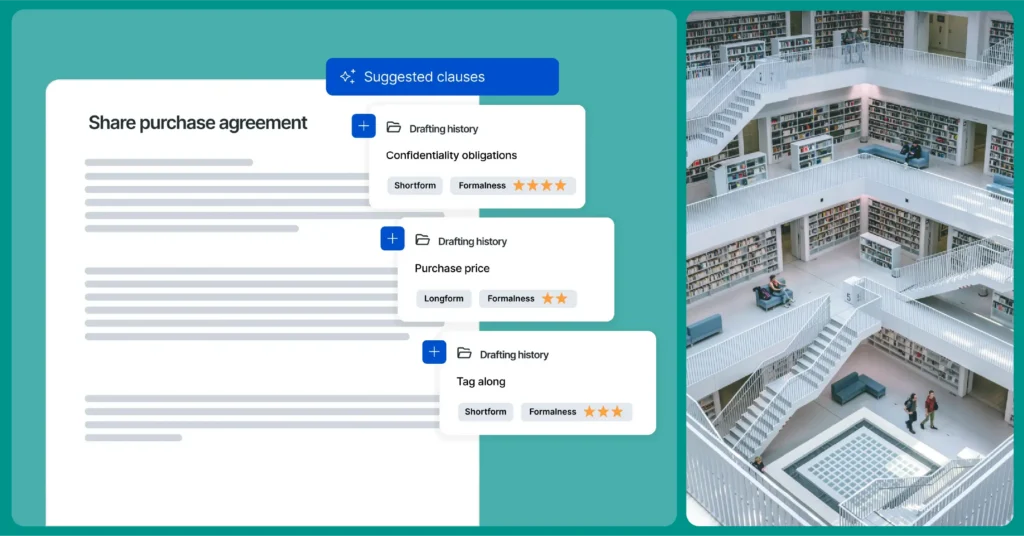
Connected to a shared clause library means that the clauses inside the template are not just static text blocks. They are connected to your approved clause library, so a change to an approved clause flows through every template and document that uses it simultaneously.
How LawVu Draft handles template management
LawVu Draft addresses the template management problem through smart templates that combine all three of the above properties, inside Microsoft Word.
Smart templates with dynamic placeholders and conditional logic. Templates built in LawVu Draft use dynamic placeholders that guide the lawyer or user through the document, conditional sections that appear or disappear based on the transaction type, and logic that adapts formatting, grammar, and cross-references automatically. The template does the work that the lawyer currently has to do manually on every draft.
Centrally managed and instantly updated. Templates are stored in a central knowledge base and accessed from within Word. When a template is updated, every subsequent use reflects the update. There is no distribution process, and no risk of outdated versions persisting in individual file stores.
Connected to the clause library. Templates draw from a shared clause library rather than containing static copies of text. When an approved clause is updated in the library, templates that reference it reflect the change. The clause library is the single source of truth for approved language.
Self-service for standard agreements. LawVu Draft includes guided questionnaires that enable business users or clients to generate simple agreements to legal standards without requiring a lawyer’s involvement in every transaction. This extends the value of templates beyond the legal team to business users who need contracts most frequently.
Fabienne Lallemand, Chief Legal and Compliance Officer at SD Worx, described what the shift to centralized template management made possible for her team:
“LawVu Draft allows our in-house lawyers to centrally manage contracts and make them available in an intelligent, user-friendly way to colleagues who need them. In this way, we streamline the operation between the legal department and the rest of the company and increase the quality of our documents.”
Fabienne Lallemand, Chief Legal and Compliance Officer at SD Worx
For law firms, the same logic applies with a different focus. The priority is ensuring consistency across fee earners and matters. Dr Frederik Leenen, former Head of Legal Tech at CMS Germany, described how LawVu Draft extended consistency across the entire firm:
“LawVu Draft covers the whole topic of knowledge management. That means you have your own clause libraries with your own templates. With AI, you can rewrite them and edit them, and when you are drafting new contracts, you don’t have to start from scratch.”
Frederik Leenen, former Head of Legal Tech at CMS Germany
The template mindset shift
The underlying shift required is from thinking of a template as a document to thinking of it as a system. A document is created, distributed, and gradually becomes outdated. A system is maintained centrally, accessed on demand, and reflects current standards at every use.
This shift has implications beyond the template itself. When templates are a system rather than documents, updating standards becomes a matter of updating the system once rather than hunting down and editing multiple files. Onboarding new lawyers becomes faster because the system enforces standards rather than relying on the new hire to have absorbed them. Quality control shifts from reviewing every document for compliance to maintaining the system that produces compliant documents by default.
Yunna Choi, Head of Legal Operations and Innovation at Axel Springer, described how LawVu Draft changed the relationship between templates and the broader drafting workflow:
“LawVu Draft stood out because it solved multiple issues we were currently dealing with within the contractual workflow, rather than focusing on a single use case. We already have contract automation tools for business teams, but we needed something that also supports our lawyers, from template automation to AI-assisted drafting and contract reviews. By embedding AI into different tasks and integrating with Word, LawVu Draft helps our team work more efficiently.”
Yunna Choi, Head of Legal Operations and Innovation at Axel Springer
Key takeaways
- Traditional contract templates are static Word documents that age quickly, multiply into uncontrolled versions, and offer no protection against deviation from approved standards.
- The five structural problems with templates are: aging, maintenance cost, version control chaos, limited interactivity, and inability to enforce drafting conventions.
- These are structural problems that cannot be solved by better file discipline or more frequent review cycles alone.
- The solution is dynamic, centralized templates connected to a shared clause library, where a single update propagates everywhere rather than requiring manual changes to multiple files.
- LawVu Draf transforms static templates into intelligent, centrally managed drafting tools that work inside Microsoft Word for both law firms and in-house legal teams.