AI contract review and compliance: answering the most common legal team questions
 Connor Amor-Bendall
While it’s true that AI contract review can make lawyers and legal teams much more efficient, it also raises concerns about compliance and security. This article addresses common compliance challenges presented by AI contract review, such as data security and confidentiality, while also exploring the security measures legal teams should prioritise when integrating AI tools into their practice.
AI contract review is the use of artificial intelligence to analyze, compare, summarize, redline, and improve contract language against legal standards, playbooks, and business requirements while keeping lawyers responsible for final legal judgment.
TL;DR
- AI contract review can improve speed, consistency, and risk detection for law firms and in-house legal teams.
- Free AI tools are not appropriate for confidential contract review unless their terms and controls meet legal requirements.
- Professional AI contract review tools should provide clear data use, retention, security, and processor terms.
- Manual anonymization often removes the productivity gains that make AI contract review valuable.
- Strong vendor due diligence should include security certifications, data processing terms, model flexibility, and control over data flows.
- Lawyers should remain accountable for legal judgment, final review, and client or business advice.
- LawVu Draft can support secure contract drafting and review inside Microsoft Word using templates, playbooks, clauses, and legal knowledge.
Why AI contract review has become a priority
Using AI contract review is quickly becoming the norm within the legal industry, thanks to the huge gains in efficiency it creates for time-poor lawyers.
Law firms use it to review third-party documents, identify risk, redline against client positions, and maintain consistency across the firm. While in-house legal teams use it to manage higher contract volumes, support the business faster, and reduce repetitive review work.
AI can automate much of this work, giving lawyers back hours of time previously spent on manual, arduous tasks and allowing them to focus on high impact work such as negotiation strategy, risk assessment, and business advice.
The benefits are increasingly measurable. LawVu Draft customers report up to 5x faster contract reviews and up to 3x faster contract negotiations when AI-powered review is combined with legal playbooks, clause libraries, and Microsoft Word workflows.
Despite the undeniable benefits, AI contract review is only valuable if lawyers trust the technology. There is still a hesitation from lawyers about incorporating the technology into their practice.
Why AI contract review raises compliance questions
Contracts contain highly confidential information such as personal data, commercial strategy, pricing, security terms, employment details, regulated data, and other privileged material.
Lawyers have professional obligations to protect this information.
Outsourcing contract review work to technology naturally raises concerns, as a poorly governed AI workflow runs the risk of exposing sensitive data, creating ethical issues, or undermining client trust. So, it’s no surprise that many legal teams and firms choose to ban its use.
Yet the reality is that legal teams and law firms are under immense pressure to do more with less. Other business departments, clients and industries are embracing technology, and with that comes an unspoken expectation that lawyers keep up with the pace of change.
The real question is not whether lawyers should use AI, but how they can harness AI contract review in a way that protects client data, preserves legal judgment, and improves the quality of legal work.
The biggest AI contract review risk is uncontrolled use
In the age of AI, there is a risk of uncontrolled use by individuals. When legal teams, respond to AI risk by banning it, but that can backfire.
When lawyers are told they cannot use approved tools, some will turn to personal AI accounts or free general-purpose tools to get work done faster. Ironically, this poses a much greater risk to the organization as it loses visibility, governance, and control.
A safer approach is to create an approved path. Legal teams should define which tools may be used, what types of documents may be uploaded, what review steps are required, and when human legal judgment must override AI suggestions.
Do LLMs use contract data to train their models?
One of the most common questions about AI contract review is whether uploaded contracts are used to train large language models (LLMs). The answer depends on the tool, the provider, and the terms that apply.
Different providers have different rules, however a clear trend emerged: If the product is free, you are the product.
Free consumer AI tools (such as the free version of Chat GPT) typically use your data to train their model unless settings or terms say otherwise. Whereas paid business tools, enterprise tools, and API-based tools usually offer stronger protections, including a commitment to not use customer data for model training.
Why it matters for law firms
Client confidentiality is imperative to law firms, as they have legal obligations to their clients to understand exactly how their information is processed, stored, and protected.
When using AI, lawyers need to know for certain that the client documents they are uploading are not being used to improve public AI models.
Why it matters for in-house legal teams
The same principle applies to in-house legal teams, who have an obligation to protect the privacy of internal business information and external customer, supplier, or contractor data.
Corporate legal teams must also evaluate how AI contract review tools affect data governance, privacy obligations, and information security requirements.
Understanding data usage is often a procurement requirement as much as a legal one.
What to check in vendor terms
Legal teams and law firms should verify terms directly before committing to an AI contract review tool. The contract with the vendor should explain whether uploaded documents, prompts, outputs, feedback, and metadata are used for training, retained for monitoring, or shared with sub-processors.
Before adopting AI contract review software, ask:
- Whether customer data is used for training
- Data retention periods
- Sub-processor arrangements
- Data residency options
- Available data processing agreements
- Security certifications
Still reviewing every contract manually?
What security controls should legal teams expect?
Security controls are the technical and organizational measures used to protect contract data throughout the AI review process. So, it goes without saying that security controls are of crucial importance to both legal teams and law firms.
When assessing different AI contract review software, you want to go with a vendor that you can trust, the problem is, how do you determine if that vendor is trustworthy?
Why it matters for law firms
Law firms must be able to demonstrate to clients and auditors that their chosen technology provider meets the same standards expected of other professional service vendors.
Why it matters for in-house legal teams
Corporate legal departments increasingly partner with IT, procurement, privacy, and security teams during vendor evaluation. With multiple stakeholders weighing in, it can be hard to find a vendor that ticks every department’s box.
Security certifications
While certifications alone do not guarantee suitability, they provide an important starting point for evaluating how seriously a vendor approaches information security.
ISO 27001 and SOC 2 are common indicators that a vendor has implemented formal security controls and processes, as they are considered gold standards for information security.
If a vendor has either certification that is a positive sign, however, it is good to note that ISO 27001 is stricter and internationally recognized, while SOC 2 has more US-focused certifications.
Clear data processing terms
Our advice is to ask for concrete evidence and a detailed explanation of their data security measures, as well as a demonstration of their software in action.
Don’t settle for vague claims of “military-grade encryption” or generic data security promises. Ask for tangible compliance measures.
A vendor should provide clear documentation explaining:
- How customer data is processed
- Whether data is retained
- Which sub-processors are involved
- Where data is hosted
- Whether customer data is used for model training
- What contractual protections are available
The ability to use your own API key
We are seeing that more legal teams are taking charge of their data infrastructure by creating their own API and LLM subscription.
An API key allows you to plug your subscription into a tool that communicates directly with the LLM to generate responses. This means you aren’t forced to use the vendor’s default API, and by avoiding this, you can ensure that any data you send to the LLM isn’t uploaded to the vendor’s servers.
For law firms, this can provide additional assurance that client data remains within approved infrastructure. For in-house legal teams, it can simplify governance, billing, procurement, and data management requirements.
A trusted vendor should give you the option to plug in your own API key and provide you with full control over where your data goes and how it is processed.
LLM-agnostic architecture
The generative AI market is rapidly evolving. The leading AI model today may be obsolete in six months or so.
With this in mind, vendors that build their products around a single LLM provider run the risk of limiting customer flexibility as new models emerge.
A vendor with LLM-agnostic architecture allows legal teams to switch between models more easily and helps future-proof AI investments. It also allows organizations to adapt to changing security requirements, procurement policies, performance expectations, and regulatory obligations.
The strongest vendors continuously monitor the AI landscape and support newer models as they become available.
Abuse monitoring exemptions
Most major LLM providers (including Microsoft and Google) operate abuse monitoring systems that review interactions with their models, identifying misuse and protecting platform integrity.
While these systems serve a very important purpose, they can cause headaches for lawyers by potentially breaching client confidentiality.
For this reason, many enterprise legal technology vendors seek abuse-monitoring exemptions or equivalent arrangements from underlying LLM providers. When granted, these exemptions can help ensure that customer contract data is not retained or reviewed beyond what is necessary to provide the service.
For law firms and in-house legal teams evaluating AI contract review software, a vendor’s ability to secure these exemptions can be a strong signal of maturity, trustworthiness, and enterprise readiness.
Auditability and human oversight
It is imperative that AI supports legal judgment and doesn’t replace it.
Clients and businesses alike are seeking the legal judgment of a lawyer, not a machine, so it is essential that a person has oversight of the AI’s contract review decisions and process.
Lawyers should be able to understand why an issue was flagged and the reasons for suggested changes. Contract review software should make it easy for lawyers to review recommendations, apply legal expertise, and maintain accountability for final decisions.
How LawVu Draft Supports AI Contract Review
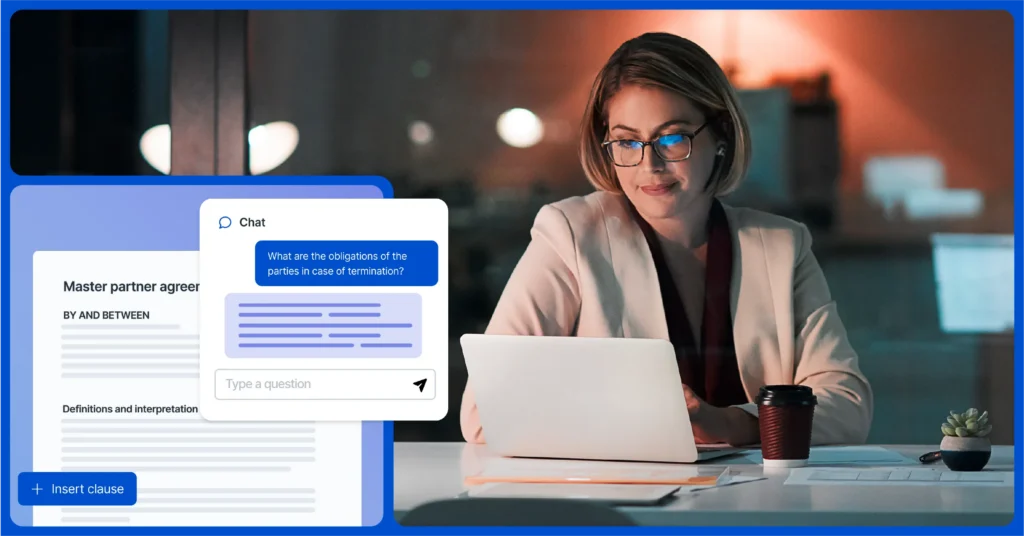
LawVu Draft can help legal teams draft, review, ask questions about contracts, refine language, and manage legal knowledge directly within Microsoft Word.
For law firms:
LawVu Draft can help firms:
- Apply client-specific review playbooks
- Standardize drafting quality
- Reuse approved clauses
- Reduce review time
- Improve consistency across teams
- Preserve institutional knowledge
“It covers the best of the old world and includes the new world of AI, blending them into something that is very neatly done. LawVu Draft is kind of a Swiss army knife. It has many different tools that all help you do what you expect them to do.”
Dr. Frederik Leenen, Former Head of Legal Tech – CMS
For in-house legal teams:
LawVu Draft can help legal departments:
- Review contracts against company policies
- Accelerate business response times
- Reduce repetitive legal work
- Surface negotiation risks earlier
- Create consistent fallback language
- Centralize legal knowledge
“LawVu Draft allows our in-house lawyers to centrally manage contracts and make them available in an intelligent, user-friendly way to colleagues who need them. In this way we streamline the operation between the legal department and the rest of the company and increase the quality of our documents.”
Fabienne Lallemand, Chief Legal and Compliance Officer – SD Worx
Key Takeaways
- AI contract review improves efficiency but does not replace legal judgment.
- Law firms and in-house legal teams require different governance controls but share many compliance concerns.
- Vendor due diligence should include security, retention, training, and data processing reviews.
- Human oversight remains essential.
- AI performs best when combined with playbooks, clause libraries, and legal knowledge.
- LawVu Draft can help legal teams review contracts up to 5x faster.
- Microsoft Word integration reduces adoption barriers and workflow disruption.