
Clause libraries: The complete guide for law firms and in-house legal teams
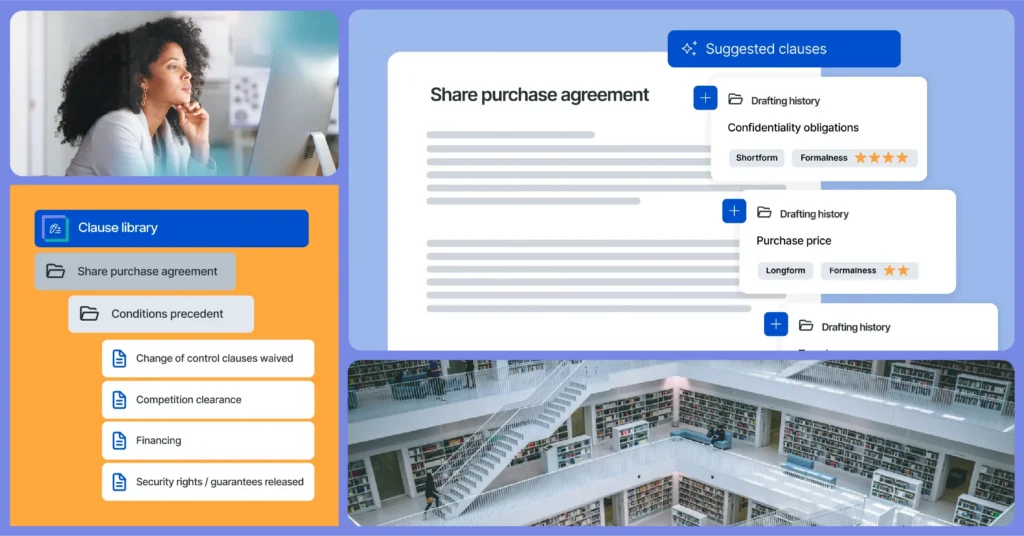
One of the most practical investments a legal team can make is also one of the most overlooked. Here is everything you need to know about clause libraries.
TL;DR
- A clause library is a curated, searchable repository of pre-approved contract clauses that legal teams and law firms can reuse across matters and documents.
- Benefits include faster drafting, fewer errors, better consistency, and easier onboarding for new lawyers
- There are two types: home-built libraries using tools like SharePoint, and purpose-built clause library software with AI capabilities.
- Purpose-built tools like LawVu Draft go further by connecting your clause library to your drafting workflow inside Microsoft Word.
- The biggest factor in whether a clause library succeeds is not technology. It is the quality and organization of the knowledge you put into it.
What is a clause library?
A clause library is a repository of standardized, pre-approved contract clauses that lawyers can search, select, and insert into documents during the drafting and review process.
For law firms, it captures the drafting standards senior partners have developed over years and makes them available to every fee earner on every matter. For in-house legal teams, it turns scattered approved positions and old contract language into a shared, trusted resource the whole department can draw from. Either way, it is your team’s institutional memory made searchable, consistent, and usable in real time.
Clause libraries typically include:
- Standard clauses with approved language (indemnity, limitation of liability, confidentiality, governing law, and so on)
- Alternative and fallback positions for negotiation scenarios
- Jurisdiction-specific and practice area-specific variants
- Metadata like tags, categories, obligation balance, and formality level
The clauses are usually reviewed and approved in advance by general counsel, senior partners, or legal ops leads, which means anyone using the library knows they are working from vetted language.
Why clause libraries matter for legal teams
The case for building a clause library is straightforward once you see how much time corporate lawyers spend doing things a library would eliminate.
Speed. The average lawyer spends a significant portion of their drafting and third-party review time searching for the right clause in old documents, emails, or shared drives, then copying, pasting, and cleaning up formatting. A well-organized clause library cuts that process to seconds.
Consistency. Without a shared library, individual lawyers on the same team will draft the same clause differently every time. That means inconsistent risk positions, inconsistent client-facing language, and inconsistent formatting. A clause library solves all three issues.
Risk reduction. Non-standardized drafting is one of the most common sources of contractual errors. When lawyers pull from a library of pre-approved, up-to-date clauses, the risk of outdated or non-compliant language making it into a final document drops significantly.
Knowledge retention. When senior lawyers leave, their drafting knowledge often leaves with them. A clause library captures that institutional expertise and makes it available to every member of the team, including new hires.
Onboarding. A new associate or in-house lawyer with access to a well-organized clause library can get up to speed on the team’s drafting standards much faster than someone who has to learn by shadowing or reviewing old files.
What AI for law firms and in-house legal teams need to do
Before getting into the types of clause libraries available, it is worth being clear about what the goal is. A clause library is not just a filing system. The real value comes from connecting your stored knowledge to the moment a lawyer needs it inside the document they are working on, without interrupting their workflow.
That is the standard a clause library solution should be judged against, whether you are a law firm trying to scale your drafting standards or an in-house team trying to reduce the time your lawyers spend hunting through old contracts.
Who benefits from clause libraries?
Law firms
For law firms, clause libraries address a challenge that gets harder as the firm grows: ensuring that every fee earner drafts to the same standard, regardless of experience level or practice area. Senior partners build years of preferred language for complex clauses, but that knowledge rarely gets systematically shared. A clause library captures it and makes it available firm wide.
Johan Geerts, Managing Partner at Geerts/Denayer, described it this way: “The search for the right tool was a long-term quest for a more innovative and modern solution to knowledge and clause management, but also the deployment of that knowledge. With LawVu Draft, we were able to create new ways of servicing our clients and generating revenue, all while also optimizing our own internal processes.”
In-house legal teams
For in-house teams, clause libraries solve a slightly different version of the same problem. The legal department has approved positions on a wide range of clause types, but those positions often live in email threads, old contracts, or the heads of a small number of senior lawyers. Every time a new contract comes in, someone must hunt down the right language rather than pulling it from a shared, trusted source.
“LawVu Draft allows our in-house lawyers to centrally manage contracts and make them available in an intelligent, user-friendly way to colleagues who need them. In this way, we streamline the operation between the legal department and the rest of the company and increase the quality of our documents.”
Fabienne Lallemand, Chief Legal and Compliance Officer at SD Worx
Two types of clause libraries
1. Home-built clause libraries
Many legal teams start by building their own clause library without specialized software. The most common approach is to store individual clauses in Word files organized through Windows Explorer, SharePoint folders, or a shared drive, with a naming convention that makes them searchable.
This works at a basic level. The clauses are stored, they are accessible, and they are better than nothing.
The limitations show up quickly. Search is keyword-only, so finding the right clause for a specific scenario depends on someone knowing exactly what to search for. Keeping the library current requires manual discipline. There is no version control, no access management, and no way to track which clauses are being used. Most importantly, inserting a clause into a document still requires manual copying and pasting, which reintroduces formatting problems.
2. Purpose-built clause library software
Specialized clause library tools are designed specifically for the workflow challenges that home-built libraries cannot address. The core difference is not just storage. It is how the library connects to the drafting and reviewing process itself.
The features that matter most in a purpose-built solution include:
Smart search and tagging. Rather than keyword-only search, purpose-built tools let you tag clauses by legal domain, obligation type, formality, jurisdiction, and other attributes. Finding the right clause for a specific deal type becomes a matter of filtering, not guessing.
Central updates. When a clause needs to change (because of a new regulation, a policy update, or a shift in your negotiating position), you update it once in the library, and it is current everywhere. There is no risk of an old version persisting in someone’s personal files.
Access controls. Not every clause is appropriate for every lawyer or every matter type. Purpose-built tools let you restrict access so that employment lawyers see employment clauses, finance lawyers see finance clauses, and junior associates see only the clauses they should be using.
Word integration. The single biggest adoption driver for any clause library is whether it meets lawyers where they work. If using the library requires switching to a different interface or platform, most lawyers will not use it consistently. The best implementations run inside Microsoft Word, where legal drafting actually happens.
“Many solutions require lawyers to work in separate platforms with Word-like text editors, which adds unnecessary friction. LawVu Draft’s deep integration with Microsoft Word was a major advantage for us. It supports our team in their existing workflow rather than forcing a system change, while also allowing us to fully leverage Word’s native formatting and tools.”
Yunna Choi, Head of Legal Operations and Innovation at Axel Springer
What AI adds to clause libraries
A clause library powered by AI goes beyond storage and retrieval. Here is what changes when AI is part of the picture.
Context-aware clause suggestions. Rather than requiring a lawyer to search for the right clause, AI can analyze the document being drafted and surface relevant clause suggestions automatically based on what is already in the contract. You are not just finding language. You are getting the right language at the right moment.
Clause extraction from precedents. One of the most time-consuming parts of building a clause library is pulling good clauses out of existing documents. AI can scan your precedent contracts, identify high-value clauses, and suggest them for inclusion in your library, turning months of manual curation work into something much faster.
Intelligent templates. LawVu Draft’s Knowledge feature lets you transform clauses and precedents into smart templates with dynamic placeholders, conditional logic, and formatting that adjusts to the document being created. You are not inserting a static block of text. You are generating a tailored version that fits the contract it is going into.
Connecting to your existing knowledge base. LawVu Draft can extract material from knowledge repositories you already use, including SharePoint, iManage, and the LawVu in-house legal workspace, so your clause library builds on what your team has already invested in rather than starting from scratch.
Dr Frederik Leenen, former Head of Legal Tech at CMS Germany, summed up the combination well: “It covers the best of the old world and includes the new world of AI, blending them into something that is very neatly done. LawVu Draft is like a Swiss army knife. It has many different tools that all help you do what you expect them to do.”
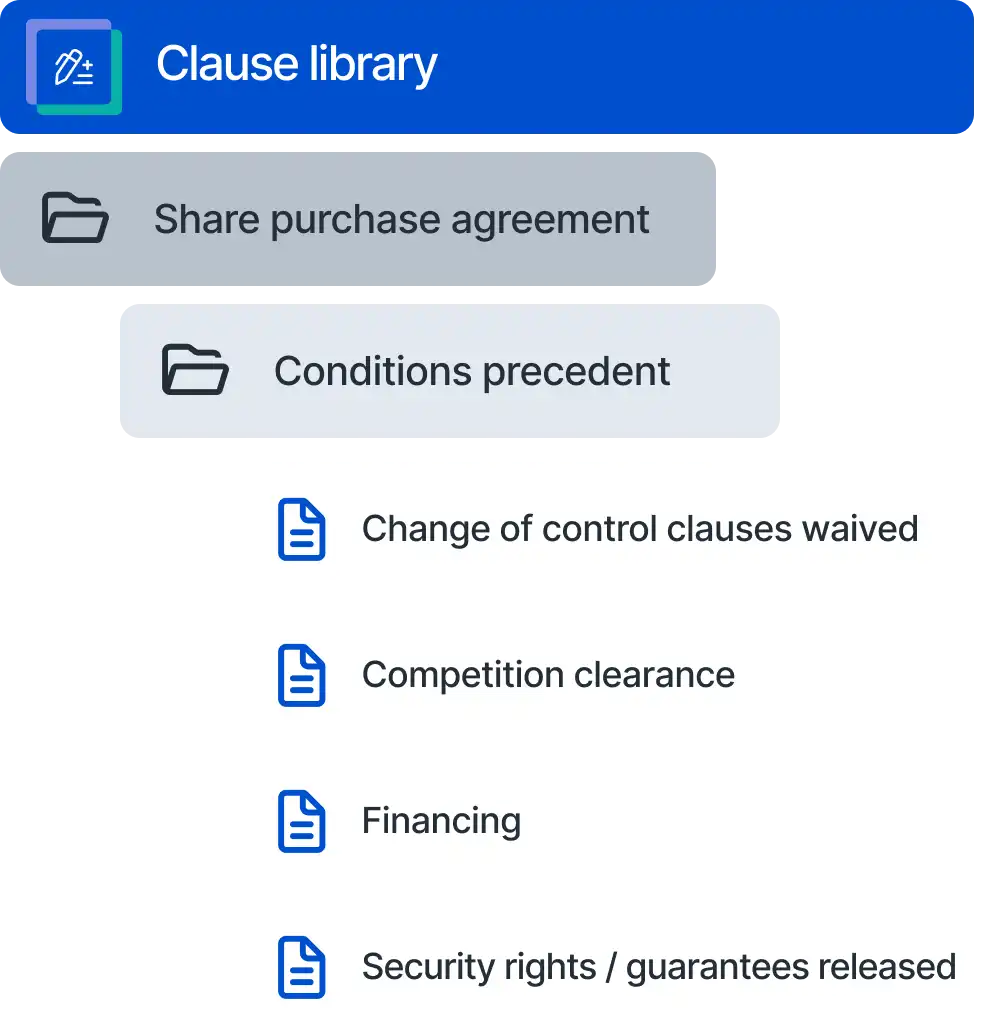
LawVu Draft’s Knowledge capabilities work inside Microsoft Word
How to build a clause library that will get used
The technology is the easier part. These are the things that determine whether a clause library succeeds in practice.
Start with your highest-use clause types. Do not try to build a complete library before you launch it. Start with the clauses your team negotiates most often (indemnity, limitation of liability, confidentiality, IP ownership, payment terms) and build out from there. A small, high-quality library is used. A large, inconsistent one does not.
Curate, do not just collect. The goal is a library of your best clauses, not a dump of everything you have ever drafted. Every clause in the library should be something a lawyer would want to use. If it is in the library, it implies that it is approved. Make sure that is true.
Keep it current. A clause library that goes stale is worse than no library at all because it gives lawyers false confidence in outdated language. Assign someone to be responsible for reviewing and updating the library on a regular basis, typically quarterly at a minimum. Make updating a clause as easy as using it.
Make it easy to contribute. The library grows more valuable as more people add to it. The best systems let lawyers extract a clause from a document they are working on and add it to the library with minimal friction, so contribution happens as a natural part of the drafting workflow rather than as a separate task.
Structured knowledge pays compound dividends. Structured knowledge compounds over time. When lawyers draw from past deals and contribute clauses back to the library, every future contract becomes faster and more consistent. Every position a lawyer documents becomes instantly available to the broader firm or business who work on similar contracts. Lawyers building this foundation today aren’t just saving time now; they’re creating an institutional knowledge asset that grows more valuable with every matter they handle.
Meet lawyers where they work. This cannot be overstated. If accessing the library requires switching contexts or opening a separate application, adoption will suffer. A tool that lives inside Word and surfaces clause suggestions without requiring the lawyer to do anything different is a tool that will get used.
What a good clause library looks like in practice
The transformation described by teams who have made the investment is consistent. What starts as a scattered, unstructured pile of precedent documents becomes a clean, searchable, shared knowledge base that every lawyer can draw from.
Axel Springer’s legal team described their before-and-after clearly. Before LawVu Draft, they referred to “a huge, unstructured pile of precedent documents to search for good clauses in. But it is hard to find good needles in a haystack like that.” The shift to a structured clause library created what they described as a virtuous cycle of knowledge sharing, where good clauses are continuously extracted, curated, and made available to the whole team.
That cycle is the real value of a clause library. It is not just about finding a clause faster today. It is about building an institutional knowledge asset that gets more useful with every matter your team works on. Whether you are a law firm protecting the consistency of your drafting standards or an in-house team trying to free your lawyers from hunting through old contracts, a clause library is the foundation for everything else.
LawVu Draft’s Knowledge capabilities work inside Microsoft Word